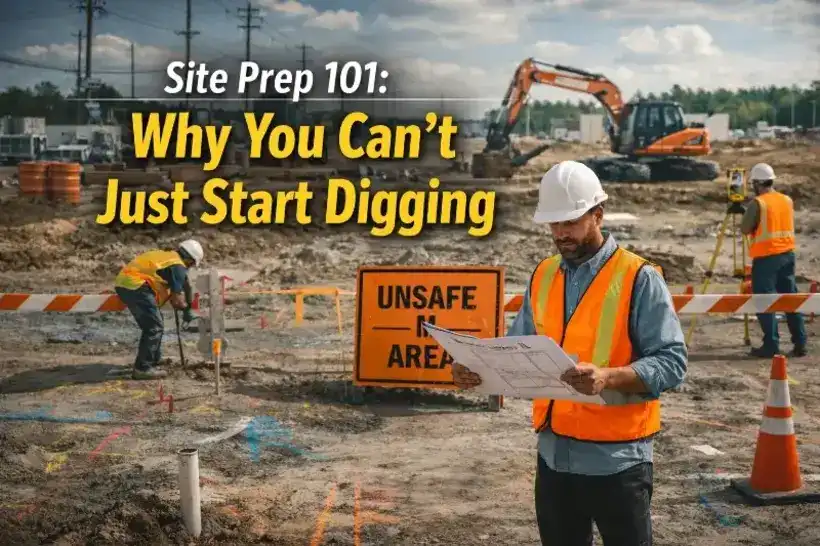
Site Prep 101: Why You Can't Just Start Digging
Most people planning a knockdown rebuild in Melbourne focus on what gets built. Very few give serious thought to what has to happen before the first excavator arrives. That oversight costs time, money, and in some cases, legal liability.
Site preparation for demolition is not a formality, it is a regulated sequence of steps that every property owner must complete before any mechanical work can legally begin. Skip one step, or do it out of order, and the entire project stalls.
In Melbourne's eastern suburbs, including established residential areas like Croydon, Ringwood, and Bayswater, these requirements apply to virtually every knockdown rebuild project, regardless of block size or structure type.
The Legal Reality: Demolition Work Cannot Start Without Permits
The first thing to understand is that demolition in Victoria is a controlled activity under law. Building demolition in Victoria is governed by the Building Act 1993 and the Building Regulations 2018, which outline the standards and guidelines for safe and responsible demolition of structures. Owner-builders cannot carry out demolition work themselves; they must engage a demolisher registered with the Victorian Building Authority as a building practitioner in the correct class.
A building permit for demolition is required before commencing work on any complete or partial removal of a building or structure. The application requires detailed plans and specifications, a site plan, details of public precautions, and, where relevant, documentation of how hazardous materials will be managed during the process.
The permit application process also triggers council involvement. Once submitted to the council, a demolition permit application can take up to approximately three weeks to process, pending that no additional information is required.
For properties in heritage overlays, planning permits may be needed before any demolition approval is granted. Greater Melbourne has 31 different councils, each with different planning rules, and Maroondah City Council, which covers Croydon, is no different. Property owners should check their zoning and overlay status through their council's planning maps before assuming demolition will be straightforward.
Getting the permit stage right from the start avoids stop-work notices later. Attempting to begin demolition before a permit is received is not just procedurally wrong, it is a legal offence under Victorian building law.
Why Service Abolishments Matter More Than People Think
Once permits are underway, the next critical stage is the full abolishment of utility services. And here is where many property owners make a costly timing error: they assume disconnection and abolishment are the same thing. They are not.
Demolition works cannot commence until both electricity and gas services have been abolished, not just disconnected. An abolishment is the complete removal of the service distribution, company metering, and servicing assets associated with the property. A simple disconnection leaves the infrastructure in place and does not satisfy the safety requirements for demolition.
Service abolitions take up to 20 business days from the date of submitting the request, as advised by utility providers. That is four calendar weeks minimum, a timeline that surprises most first-time demolition clients. Submitting electricity and gas abolishment applications simultaneously is strongly recommended to avoid those waits running consecutively rather than concurrently.
For electricity, property owners require their 11-digit NMI (National Meter Identifier), found on the electricity bill. For gas, the equivalent is the Meter Identification Reference Number (MIRN). Due to privacy laws, only the authorised account holder can arrange these abolitions with the service provider. Delegating this task to a builder or demolition contractor is not possible; it sits with the owner.
The consequences of overlooking abolitions are severe. Live services beneath or adjacent to a demolition zone represent an active electrocution and explosion risk for operators, neighbouring properties, and the public. No reputable demolition contractor will bring machinery onto a site where these services remain live.
Sewer and Stormwater Capping: The Step That Protects the Whole Street
Of all the pre-demolition requirements, sewer and stormwater capping is perhaps the least understood and among the most consequential if it goes wrong.
All buildings and homes have a working sewer line that must be closed off before demolition proceeds. This is not optional; authorities mandate it as a specific legal requirement to demolish a structure. Partial and full demolitions generate large amounts of dirt, debris, and other materials that will clog sewer lines, even far away from the property scheduled for demolition.
The ingress of demolition waste into the sewer system creates blockages that can affect neighbouring properties, overwhelm stormwater drainage infrastructure, and, in worst-case scenarios, produce surface sewage overflow that presents a serious public health risk.
Under the Utilities Act 2000, it is an offence for demolition waste, groundwater, stormwater, or unapproved liquids to enter the sewer system. The potential for toxic elements discovered during demolition, asbestos fragments, volatile chemicals, and contaminated soil to reach water treatment facilities is another driver of this requirement. Capping the sewer ensures that the right disposal methods are used to remove these elements from the site before they can contaminate shared infrastructure.
Capping off the main sewer line is a mandatory compliance step to ensure your demolition contractor Melbourne doesn't trigger a neighbourhood health hazard when the excavators arrive. In Melbourne's eastern suburbs, where older homes often still have clay sewer or stormwater pipes, this step requires particular care.
Clay pipes crack, shift, and crumble during excavation, so a licensed plumber must cap the sewer line back to the relevant authority point, and all old stormwater or sewer piping on the property is removed during demolition and excavation.
Sewer capping is not a DIY task. It must be carried out by a licensed plumber under Victorian plumbing regulations, and upon completion, the plumber issues a clearance certification. Yarra Valley Water, which services a large portion of Melbourne's eastern suburbs, including the Maroondah Council area, requires property owners to apply online for approval before work begins, with options to either cap off the private internal property sewerage drain or engage a licensed live sewer contractor to cut, seal, or relocate the connection point.
Build-over easement guidelines must also be considered when planning new construction following demolition, as there are restrictions on work undertaken over Yarra Valley Water assets or within one metre of their infrastructure.
Asbestos: The Hidden Variable That Changes Everything
For any residential demolition project in Melbourne, asbestos is not a distant risk, it is a near certainty in older housing stock. Any Melbourne home built before 1990 is likely to contain asbestos, and licensed removal is mandatory under the Occupational Health and Safety Regulations 2017. No DIY approach is legally permissible.
Asbestos was used in an enormous range of building materials: cement sheet lining in eaves, kitchen and bathroom wall linings behind tiles, faux brick and weatherboard cladding, and floor adhesives. In many Croydon properties built during the 1950s through 1980s, multiple asbestos-containing materials can be present simultaneously, requiring staged identification and removal.
The standard process begins with a licensed asbestos removalist engaged as part of the demolition quotation. The removalist is engaged before any physical work begins, and the demolition contractor notifies WorkSafe Victoria of the removal before commencement.
Once the asbestos has been removed and transported in an EPA-registered vehicle to an EPA-licensed landfill, an independent asbestos hygienist inspects the property and issues a clearance certificate. Only then can demolition proceed.
One important caveat: asbestos buried in the ground or beneath concrete slabs is sometimes not discovered until excavation begins. When this occurs, the contractor halts work, contacts the property owner, and arranges separate assessment and disposal at additional cost. Accounting for this possibility in the project budget and timeline removes the element of surprise if it arises.
Tree Removal Permits: Often Overlooked Until Too Late
Tree removal is a component of site preparation that catches many Croydon property owners off guard. Not all trees on a block can simply be cleared ahead of demolition. Local councils have regulations for tree removal that vary considerably depending on the size and species of tree, and whether the property carries a significant landscape overlay or vegetation protection overlay.
The Vegetation Protection Overlay means certain trees cannot be removed without council permission and, in some cases, cannot be removed at all. The Maroondah Council planning scheme contains specific provisions around locally significant trees. Failing to check tree permit requirements before engaging a demolition contractor can result in a stop-work notice and potential fines for the unlawful removal of protected vegetation.
Tree permit applications should be submitted to the council as early as possible in the pre-demolition process. If a tree permit is required, waiting until the demolition permit is approved to begin the tree application adds unnecessary delay to the project timeline. Running both applications concurrently, where the specific tree removal plans are known, compresses the overall schedule.
Asset Protection: Safeguarding the Street During Demolition
Before any demolition machines arrive on site, an asset protection permit must be obtained from the local council. This permit is specifically designed to protect council-owned infrastructure roads, drains, nature strips, kerbs, and footpaths from damage caused by heavy machinery and site traffic during demolition and construction works.
The application process for asset protection requires the property owner to pay a bond that the council holds for the duration of the demolition and building project. The bond is refunded upon completion, provided no damage has occurred to the surrounding infrastructure. Taking photographs of the existing footpath, kerbs, and roadway before demolition begins creates a documented baseline that protects the owner against disputed damage claims.
Temporary fencing is also required around the demolition site as a precondition of the permit. This protects both the public and workers from the hazards associated with active demolition, and is a non-negotiable condition of any compliant demolition project in Victoria.
Getting the Sequencing Right
The most common reason Melbourne demolition projects run over time and over budget is poor sequencing of the pre-demolition steps. Each requirement has its own lead time, and many cannot begin until a preceding step is complete.
A realistic timeline for a straightforward Croydon demolition project, one with no heritage overlay and no unexpected soil contamination, typically looks like this. In the first week, the demolition contractor submits the Section 29A heritage check application to the council. Concurrently, the property owner initiates electricity and gas abolition applications with their respective providers.
The building permit application is submitted once the heritage check response (Form B) is received, which typically takes up to 20 working days. Tree permit applications are lodged simultaneously with the building permit application where trees are to be removed.
Once the building permit is issued, asbestos inspection and removal proceed, followed by the licensed plumber completing sewer and stormwater capping and issuing clearance certification. With all services abolished, all hazardous materials removed, and sewer capping certified, the demolition permit conditions are satisfied, and the contractor can mobilise.
The entire pre-demolition sequence commonly takes between six and ten weeks when all steps proceed without complications. Projects that attempt to compress this timeline by skipping or delaying regulatory steps inevitably experience delays imposed by council, utility providers, or WorkSafe at greater cost and with greater disruption than if the sequence had been followed properly from the start.
Working With the Right Demolition Contractor
Choosing a demolition contractor who understands the full pre-demolition compliance sequence is as important as choosing one with the right machinery. A qualified contractor coordinates the building permit application through their registered building surveyor, guides the property owner through the service abolishment process, arranges the asbestos inspection and licensed removal, coordinates the licensed plumber for sewer capping, and handles protection works notices to neighbours where shared boundary structures are involved.
A registered demolition contractor in Victoria holds a current registration with the Victorian Building Authority and carries public liability insurance for demolition works. Ask any contractor you are considering for evidence of both before signing an engagement.
Contractors who can demonstrate experience specifically with Melbourne's eastern suburbs, including familiarity with Maroondah Council's specific permit processes and knowledge of the clay sewer infrastructure common to older Croydon properties, bring material value to the project beyond the day-rate for machinery.
Conclusion
Site preparation for demolition in Melbourne is a multi-step compliance process that takes weeks, requires multiple licensed professionals, and follows a legally prescribed sequence. Electricity and gas abolitions, sewer and stormwater capping, asbestos inspection and clearance, tree permits, asset protection bonds, and building permits for demolition must all be in place before mechanical work begins.
Property owners who understand this sequence early can plan accordingly, avoid the delays that catch uninformed applicants off guard, and give their knockdown rebuild project the cleanest possible start. In a suburb like Croydon, where older housing stock, clay drainage infrastructure, and council vegetation protections all feature prominently, that preparation is not optional; it is the project.